




September 18, 2025

September 10, 2025
July 3, 2025
January 10, 2025
Income Tax for Domestic Company: Tax Slabs, Forms & Deductions – FY 2025-26

Author
Shoonya Team
Income tax filing is mandatory for domestic companies in India. Depending on turnover, tax regime, deductions claimed, and the nature of business, a domestic company may be taxed at different specified rates and may also be subject to surcharge, cess, and additional compliance requirements.
This guide explains the applicable tax rates, deductions, return forms, and filing requirements for domestic companies under the 2026 framework.
What is the Importance of Filing ITR for a Domestic Company
- Filing taxes is a legal obligation for domestic companies in India.
- It helps maintain financial transparency and builds credibility with investors, lenders, and regulatory authorities.
- Companies that regularly file taxes can carry forward losses to offset future profits, reducing their tax liability.
- It strengthens corporate governance and enhances a company’s market reputation.
Income Tax Rate for Domestic Companies in India (Tax Year 2026-27)
Here are the details of the domestic company tax slab in India!
| Condition | Income Tax Rate (excluding surcharge and cess) |
| Turnover or Gross Receipts in FY 2020-21 up to ₹400 crore | 25% |
| Opted for Section 115BA | 25% |
| Opted for Section 115BAA | 22% |
| Opted for Section 115BAB | 15% |
| Any other Domestic Company | 30% |
Domestic companies are not taxed through slab progression like individual taxpayers. Instead, the applicable rate depends on turnover thresholds or the concessional regime chosen under the law.
Surcharge and Other Charges in Company Income Tax
- Surcharge: 7% where total income exceeds ₹1 crore but does not exceed ₹10 crore
- Surcharge: 12% where total income exceeds ₹10 crore
- Surcharge for 115BAA / 115BAB companies: 10%, irrespective of total income
- Marginal relief: available where surcharge exceeds the additional income over the threshold
- Health and education cess: 4% on tax plus surcharge
- MAT: generally 15% of book profit, plus surcharge and cess, where applicable
- MAT for certain IFSC companies: 9% in specified cases
- Companies opting for section 115BAA or section 115BAB are not liable to MAT
Key Deductions and Tax Benefits for Domestic Companies
A domestic company in India can claim tax deductions under various sections, such as 80JJAA (new employment generation), 80G (donations), and 35 (R&D expenses).
- Donations (Section 80G & 80GGA): Companies can claim deductions on donations to charitable institutions, scientific research, or rural development (up to 100%, subject to limits). Cash donations above ₹2,000 are not eligible.
- Political Contributions (Section 80GGB): Any contribution to political parties or electoral trusts is fully deductible if paid through non-cash modes.
- Infrastructure & SEZ (Sections 80IA, 80IAB, 80IC, 80IE): Businesses in infrastructure, SEZs, and North-Eastern states can claim 100% profit deductions for a specific period.
- Startups & Employment Benefits (Sections 80IAC, 80JJAA): Eligible startups get 100% tax exemption for 3 out of 10 years, while companies hiring new employees can deduct 30% of their additional employee cost for 3 years.
- Inter-Corporate Dividends (Section 80M): A domestic company can claim deductions on dividends received from other companies if they are redistributed to shareholders before the ITR filing due date.
Tax-saving options for a domestic company are numerous.
| Section | Deduction Details |
| 80G | Donations to charitable funds (50%-100% deduction) |
| 80GGA | Donations for scientific research & rural development |
| 80GGB | Contributions to political parties (non-cash only) |
| 80IA | 100% deduction for 10 years (Infrastructure & Power) |
| 80IAB | 100% deduction for 10 years (Special Economic Zones) |
| 80IAC | 100% deduction for 3 years (Start-ups) |
| 80IB | 100% deduction for 5-10 years (Manufacturing & Food Processing) |
| 80IBA | 100% deduction (Affordable Housing Projects) |
| 80IC | 100% deduction for 5 years, then 25% (30% for companies) (Himachal, Sikkim, North-East) |
| 80IE | 100% deduction for 10 years (Industries in North-East) |
| 80JJA | 100% deduction for 5 years (Biodegradable Waste Processing) |
| 80JJAA | 30% deduction on additional employee costs for 3 years |
| 80LA | 100% deduction for 5 years, then 50% for the next 5 years (IFSC & Offshore Banking) |
| 80M | Deduction for inter-corporate dividends distributed |
| 80PA | 100% deduction for Producer Companies (AY 2019-20 to 2025-26, turnover < ₹100 Cr) |
Which ITR Form Applies to a Domestic Company?
In most cases, domestic companies file either ITR-6 or ITR-7, depending on the nature of the entity and whether an exemption under section 11 is claimed.
| ITR Form | Applicable To | When to Use |
| ITR-6 | Domestic companies other than those claiming exemption under section 11 | For companies with taxable business or professional income |
| ITR-7 | Companies and institutions required to file under sections 139(4A), 139(4B), 139(4C), or 139(4D) | Where income is reported under the specific categories covered by these provisions |
1. ITR-6
This form applies to all companies except those claiming exemption under Section 11 (income from property held for charitable or religious purposes).
Companies eligible to file ITR-6:
- Indian companies
- Foreign body corporates operating in India
- Any association, institution, or body (Indian or non-Indian) declared as a company by the Board
2. ITR-7
This form applies to companies required to file returns under Sections 139(4A), 139(4B), 139(4C), or 139(4D), such as:
- Section 139(4A): Companies receiving income from property held for charitable or religious purposes
- Section 139(4B): Political parties
- Section 139(4C): Entities like research associations, news agencies, etc.
- Section 139(4D): Universities, colleges, or institutions referred under Section 35
Important Compliance Forms and Reports for Domestic Companies
Domestic company tax filing may require the following ITR forms!
| Form / Report | Purpose |
| ITR-6 | Main return form for companies not required to file ITR-7 |
| ITR-7 | Return form for specified institutions filing under sections 139(4A) to 139(4D) |
| Form 26 | Tax audit report under the renumbered 2026 framework, corresponding to earlier Forms 3CA / 3CB / 3CD |
| Form 48 | Transfer pricing audit report under the renumbered 2026 framework, corresponding to earlier Form 3CEB |
| Form 66 | MAT-related certification under the renumbered 2026 framework, corresponding to earlier Form 29B |
| Form 131 | TDS certificate counterpart under the renumbered 2026 framework, corresponding to earlier Form 16A |
| Form 44 | Statement for foreign tax credit under the 2026 framework, corresponding to the old Form 67 |
| Form 168 | Annual information statement structure under the new framework |
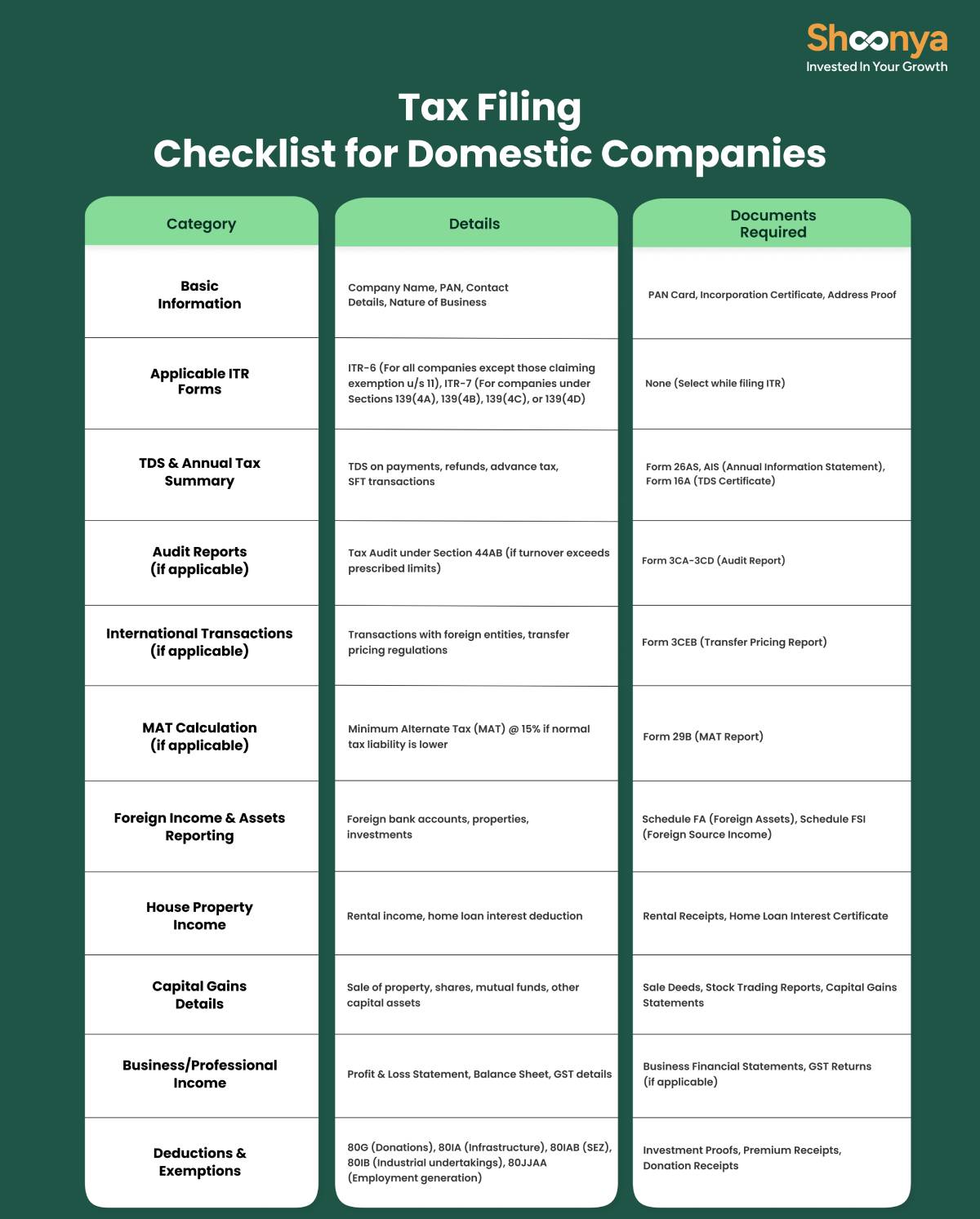
ITR Filing Checklist for Domestic Companies
Before filing your Income Tax Return (ITR), as a domestic company in India, you must ensure that you have all the necessary documents and details ready. Here’s a quick checklist to help your company stay compliant and avoid errors:
How to File ITR for a Domestic Company in FY 25-26
Filing an Income Tax Return (ITR) for a domestic company is different from individual filings.
Below is a step-by-step guide for filing ITR-6 & ITR-7 online through the Income Tax e-Filing portal.
Step 1: Register on the e-Filing Portal
- Visit the Income Tax e-Filing Portal: https://www.incometax.gov.in
- Click on “Register” and choose Company as the user type.
- Enter PAN, email ID, and mobile number to complete the registration.
Step 2: Log In
- Use your Company PAN as the User ID.
- Enter your password and captcha code to log in.
Step 3: Choose the Correct ITR Form
- ITR-6 → For companies not claiming exemption under Section 11 (income from property held for charitable/religious purposes).
- ITR-7 → For companies required to file returns under Sections 139(4A), 139(4B), 139(4C), or 139(4D) (such as charitable trusts, political parties, or research associations).
Step 4: Pre-Fill Company Data
- The portal auto-fills data from Form 26AS, TDS details, and previous ITRs.
- Verify and update revenue, expenses, depreciation, and tax payments.
Step 5: Enter Financial & Tax Details
- Fill in income details from the Profit & Loss Account and Balance Sheet.
- Enter deductions and exemptions under applicable sections.
- Include Tax Deducted at Source (TDS) details.
Step 6: Review and Validate Information
- Ensure that total income, deductions, and tax liabilities are correctly entered.
- Use the “Validate” button to check for errors.
Step 7: Calculate & Pay Tax (if applicable)
- The system will automatically calculate the company tax liability.
- Pay any outstanding tax via net banking, debit card, or challan before submission.
Step 8: Submit the ITR & E-Verify
- Click “Submit” and choose an e-Verification method:
- Digital Signature Certificate (DSC) – Mandatory for companies
- Electronic Verification Code (EVC) via net banking (if applicable)
Step 9: Get ITR Acknowledgement
- Once filed, the portal generates an ITR-V Acknowledgement.
- Save it for future reference.
Important Points for domestic company ITR filing:
- ITR-6 is the most commonly used form for corporate tax filing.
- Companies must file ITR electronically using a Digital Signature Certificate (DSC).
- The due date for filing ITR for domestic companies is usually October 31 of the assessment year (AY).
- ITR-7 applies to specific institutions and requires proper documentation.
- Failure to file within the due date results in penalties.
What are the Benefits of Filing ITR for a Domestic Company
Domestic companies that file taxes on time can take advantage of various benefits:
- Lower tax rates under special provisions, such as Section 115BAA (22%) and Section 115BAB (15%).
- Proper tax filing enables businesses to qualify for government schemes, subsidies, and incentives designed to promote industry growth.
- It ensures eligibility for tax refunds if excess tax was paid during the year.
- Companies engaged in research, infrastructure, or manufacturing can claim additional deductions under sections 80IA, 80IB, and 80IC, leading to significant tax savings.
What are the Common Mistakes to Avoid While Filing ITR for Domestic Companies
Filing income tax for a domestic company requires careful attention to detail to avoid errors that can lead to penalties. Here are common mistakes to watch out for:
- Using AY language in a 2026-rules article: If the article is meant for the post-1 April 2026 framework, use Tax Year 2026-27 rather than AY 2026-27 as the main reference.
- Selecting the wrong return form: ITR-6 and ITR-7 apply in different situations and should not be used interchangeably.
- Using old form numbers without noting the 2026 renumbering: Forms such as 3CA/3CB/3CD, 3CEB, 29B, 16A, and 67 have corresponding renumbered forms under the 2026 framework.
- Incorrectly claiming deductions after opting for concessional tax regimes: Companies under section 115BAA or 115BAB need to verify which deductions remain available.
- Ignoring surcharge, cess, or MAT implications: These can materially change the final tax outgo even when the base rate appears straightforward.
Things to Keep in Mind While Filing Income Tax for a Domestic Company
Filing income tax for a domestic company involves multiple steps, and careful planning can help avoid unnecessary penalties. Here are some important things to keep in mind:
1. Understand Your Tax Slab & Applicable Tax Rate
- The corporate tax rate in India depends on the company’s turnover and chosen tax regime:
- 25% for companies with turnover up to ₹400 crore.
- 22% under Section 115BAA (no exemptions allowed).
- 15% under Section 115BAB (for new manufacturing companies).
- 30% for other companies.
- Choosing the right company tax slab ensures correct tax computation.
2. Ensure Timely Tax Payments & Compliance
- Advance tax must be paid in four instalments if the tax liability exceeds ₹10,000.
- A Minimum Alternate Tax (MAT) at 15% of book profits applies unless the company opts for Sections 115BAA or 115BAB.
3. Maintain Accurate Financial & Tax Records
- Keep records of:
- Balance sheets and profit & loss statements.
- Tax Deducted at Source (TDS) certificates.
- Form 26AS and AIS (Annual Information Statement).
- GST details and advance tax receipts.
- Using an income tax calculator can help estimate tax liability in advance.
4. Utilise Available Tax Deductions & Benefits
- Income tax deductions for domestic companies include:
- Section 80G (Donations to charitable institutions).
- Section 80JJAA (Hiring new employees).
- Section 80M (Inter-corporate dividends).
- Companies under 115BAA and 115BAB cannot claim most deductions.
5. File Mandatory Forms for Special Tax Rates
- To opt for lower corporate tax rates, companies must file:
- Form 10-IC (for 22% tax under Section 115BAA).
- Form 10-ID (for 15% tax under Section 115BAB).
- Missing these forms results in a higher tax liability.
Filing taxes for a domestic company requires the correct return form, accurate tax-rate selection, proper reporting of deductions and tax credits, and attention to the updated compliance framework. A structured review before filing can help reduce errors and improve compliance.
Income Tax for Domestic Companies (AY 2026-27): FAQs
Corporate tax in India is the tax levied on the net income or profits of a company. Domestic companies and foreign companies operating in India are required to pay corporate tax based on their earnings and applicable tax slabs.
The corporate tax in India is calculated based on a company’s taxable income after deductions, exemptions, and applicable tax rates.
An income tax calculator helps businesses estimate their tax liability by considering taxable income, deductions, and applicable corporate tax rates in India.
A company is required to file ITR-6, except for companies that claim exemption under Section 11 for income from property held for charitable or religious purposes.
The income tax rate for a domestic company ranges from 15% to 30%, depending on the company’s turnover and the tax regime it has opted for.
The applicable rate may be 15%, 22%, 25%, or 30%, depending on turnover and whether the company has opted for sections 115BA, 115BAA, or 115BAB.
The type of Income Tax Return (ITR) form for business income depends on the nature and size of the business. ITR-3 is applicable for individuals and Hindu Undivided Families (HUFs) having business or professional income. ITR-4 is for small businesses opting for the presumptive taxation scheme. ITR-6 is for companies, except those exempt under Section 11.
As per Section 2(22A) of the Income Tax Act, a domestic company refers to an Indian company or any other company that pays dividends in India from its taxable income and has made the necessary arrangements for such payments.
The tax slab for a company is structured based on its turnover and the tax scheme it chooses. Companies with a turnover of up to ₹400 crore in the previous financial year are subject to a 25% tax rate, while companies with a higher turnover pay 30% tax.
ITR-4 is applicable to individuals, Hindu Undivided Families (HUFs), and partnership firms (excluding LLPs) that have business or professional income and opt for the presumptive taxation scheme under Sections 44AD, 44ADA, or 44AE.
Source- Incometax.gov.in
Disclaimer: This content is for education and awareness purposes only and should not be considered investment advice or a recommendation. Investments in securities markets are subject to market risks. Read all the related documents carefully before investing.


Explore Our Offerings

Stocks
Trade equities across NSE and BSE with zero delivery charges. Invest, hold or sell with a seamless experience.


Future & Options
Execute complex strategies with simple tools and real-time data.

IPOs
Apply to the latest IPOs in just a few taps. Stay updated and capture opportunities as they open.