




September 18, 2025

September 10, 2025
July 3, 2025
January 10, 2025
Can a Daughter-in-Law Become a Karta of a Hindu Undivided Family?

Author
Shoonya Team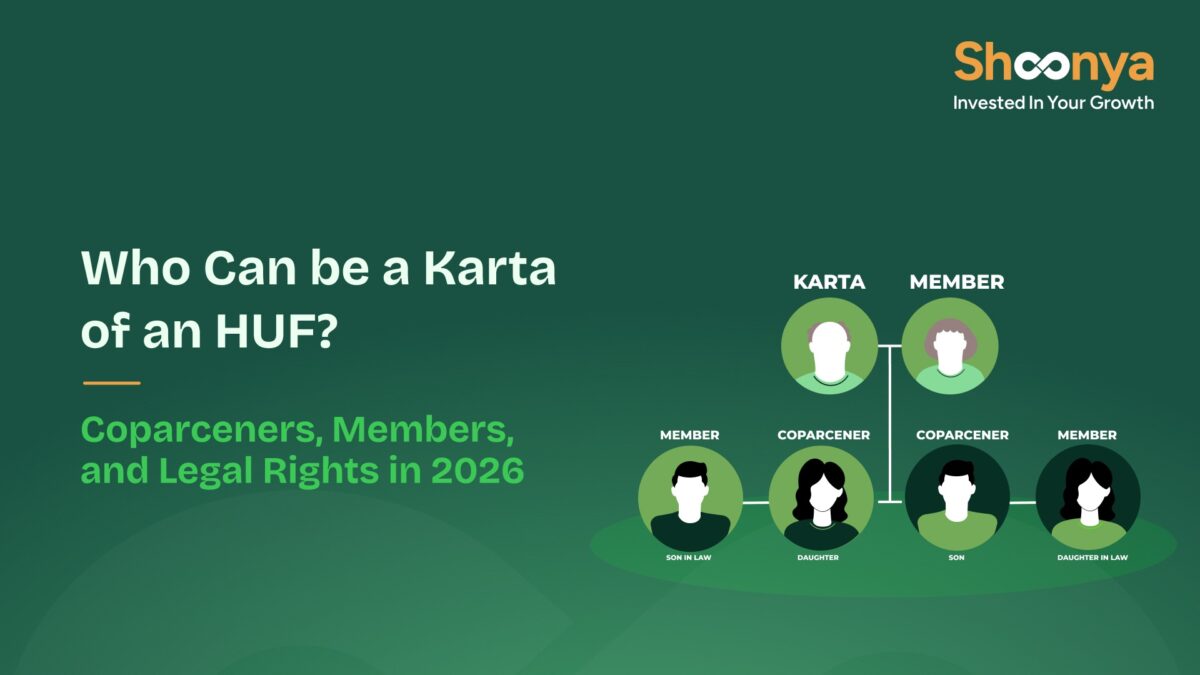
In many Indian households, ancestral property, investments, and business income are often structured under a Hindu Undivided Family (HUF).
Since an HUF is treated as a separate “person” under the Income Tax Act, it can hold property, open bank and demat accounts, invest in shares and mutual funds, and even run businesses, all with distinct tax implications.
Traditionally, only the senior-most male member could act as Karta, but with evolving inheritance laws and changing financial roles, one question remains practically relevant for many Indian families: Can a woman be ‘Karta’ of an HUF?
Here is what the law says.
Who Is a Karta in Hindu Law?
A Hindu Undivided Family consists of lineal descendants of a common ancestor, typically within 4 generations.
Its structure is around three key roles:
- Karta – Head and decision-maker of the HUF
- Coparceners – Members with a birthright in ancestral property
- Members – Other family members entitled to benefits
The Karta is the managing authority of the HUF and represents it in all legal and financial matters.
The role of Karta includes:
- Managing ancestral property (movable and immovable)
- Handling financial and tax matters
- Representing the HUF in legal proceedings
- Entering contracts and business agreements
- Acting on behalf of the family in courts and business transactions
Discover how HUF income is taxed and what deductions you can claim – HUF Income Tax
Can a Woman Be Karta of an HUF in 2026?
Whether a woman can be a Karta depends entirely on whether she is a coparcener.
What Is a Coparcener in an HUF?
A coparcener is a person who acquires a birthright in the ancestral property of a Hindu Undivided Family.
Under Hindu law:
- A coparcener is a lineal descendant of a common ancestor within four generations.
- Coparcenary rights arise by birth, not by marriage.
- Both sons and daughters are coparceners.
- A coparcener has the right to demand partition of the HUF property.
Note: All coparceners are members of the HUF, but not all members are coparceners.
Can a Daughter Become Karta of a Hindu Undivided Family?
Yes, the daughter is a coparcener by birth.
After the Hindu Succession (Amendment) Act, 2005, daughters were granted equal coparcenary rights by birth under Section 6 of the Hindu Succession Act, 1956.
This means:
- A daughter is a coparcener by birth, just like a son.
- She has equal rights and liabilities in ancestral property.
- If she is the senior-most coparcener, she can become the Karta of the HUF.
The legal position was further clarified by the Supreme Court in Vineeta Sharma v. Rakesh Sharma (2020), which held that a daughter’s coparcenary right exists by birth, irrespective of whether the father was alive on 9 September 2005.
So, in 2026, gender is no longer a barrier. Seniority among coparceners determines who becomes Karta.
Women today are not only gaining equal legal rights in family wealth but are also leading businesses across India.
Explore the top 10 women entrepreneurs in India and their inspiring journeys.
Can a Daughter-in-Law Become Karta of a HUF?
No, a daughter-in-law becomes a member of her husband’s HUF by marriage.
However:
- She is not a coparcener in her husband’s HUF.
- She does not acquire a birthright in ancestral property.
- Since only a coparcener can become Karta, she generally cannot hold that position.
However, she may become Karta in her own natal HUF if she is a coparcener there and is the senior-most member.
What are the Rights of Coparceners in an HUF
A coparcener, whether major or minor, has specific legal rights in the Hindu Undivided Family.
- Right to Demand Partition: A coparcener has the legal right to seek partition of the HUF property at any time. If such a demand is made, the Karta is legally obligated to act on it.
- Right to Equal Share: Every coparcener is entitled to an equal share in ancestral property. However, the exact share is determined only at the time of partition, based on the number of coparceners existing then.
- Right to Joint Possession: Coparceners have joint ownership in HUF property, whether movable or immovable.
- Right to Challenge Decisions: If the Karta mismanages property, acts beyond authority, or makes decisions against the family’s interest, a coparcener can legally challenge those actions.
Can an HUF Invest in the Stock Market?
Yes, HUF can invest in the stock market. It can participate in financial markets independently through its authorised signatory, the Karta, who manages all financial and investment decisions on behalf of the HUF.
As a separate taxable entity, an HUF can:
- Open a bank account in the name of the HUF
- Open a demat and trading account
- Invest in shares, mutual funds, IPOs, ETFs, and bonds
- Earn capital gains and business income
- File its own income tax return separately
To begin investing under the HUF structure, the Karta must open a dedicated HUF demat and trading account.
Know the quick steps to open an HUF account.
Conclusion
In 2026, eligibility depends on coparcenary status, not gender. A daughter, being a coparcener by birth, can become Karta if she is the senior-most coparcener. A daughter-in-law, however, remains a member by marriage and generally cannot assume that role in her husband’s HUF.
If you are managing ancestral assets or planning structured investments under an HUF, opening a dedicated HUF demat account ensures proper segregation of family wealth and compliance-ready investing.
Karta of Hindu Undivided Family: FAQs
A coparcener is a person who acquires a birthright in ancestral property and has the right to demand partition. A member may receive benefits from the HUF but does not have a birthright in property and cannot demand partition.
After the death of the Karta, the role passes to the senior-most coparcener of the HUF, regardless of gender.
Yes, a female Karta has the same authority as a male Karta to open and operate bank accounts, demat accounts, and manage investments on behalf of the HUF.
No, a minor coparcener cannot act as Karta. If the senior-most coparcener is a minor, an adult coparcener typically manages the affairs until the minor attains majority.
No, marriage does not extinguish a daughter’s coparcenary rights in her natal HUF. She continues to remain a coparcener by birth even after marriage.
A daughter’s children do not automatically become coparceners in their maternal grandfather’s HUF. Coparcenary rights arise through lineal descent in the male line under traditional Mitakshara law.
Yes, an adopted child is treated as a natural-born child under Hindu law and becomes a coparcener by adoption.
A wife is a member of her husband’s HUF by marriage but is not a coparcener. However, if the surviving coparceners are minors, courts have recognised that a widow may manage the HUF’s affairs as a guardian until a coparcener attains majority.
Source: https://www.moneycontrol.com
Disclaimer: Investments in the securities market are subject to market risks; read all the related documents carefully before investing.


Explore Our Offerings

Stocks
Trade equities across NSE and BSE with zero delivery charges. Invest, hold or sell with a seamless experience.


Future & Options
Execute complex strategies with simple tools and real-time data.

IPOs
Apply to the latest IPOs in just a few taps. Stay updated and capture opportunities as they open.