



September 18, 2025

September 10, 2025
July 3, 2025
January 10, 2025
Electronic Gold Receipts(EGRs): Meaning, Benefits and How to Buy EGRs in India (2026)

Author
Shoonya Team
Gold has always been one of India’s most trusted assets, but trading it has often involved concerns related to purity, storage, pricing, and resale transparency.
To make gold trading more organised, the National Stock Exchange launched Electronic Gold Receipts (EGRs) as a new segment on May 4, 2026. The aim is to increase transparency, efficiency, and formalisation in India’s gold market through a regulated exchange-based platform.
In this blog, you will learn what EGRs are, how they work, how to buy them in India, and what factors to consider before investing.
What are EGRs?
The full form of EGR is Electronic Gold Receipts.
Gold Receipts Meaning: EGRs are digital certificates issued against deposited physical gold. They represent ownership of gold in demat form and can be traded on stock exchanges like other securities.
Why Were Electronic Gold Receipts (EGRs) Introduced in India?
Electronic Gold Receipts were introduced in India to connect the traditional physical gold market with the regulated financial market.
The Ministry of Finance first recognised EGRs as securities in 2021. Following this, SEBI created the framework for the Gold Exchange and EGR trading. This gave exchanges, depositories, clearing corporations, and vault managers a structured role in the EGR ecosystem.
NSE launched EGRs as a new segment on May 4, 2026. This marked a major step towards regulated, exchange-based gold trading in India
What are the Key Features of Electronic Gold Receipts?
EGRs can be traded like other exchange-listed securities, with defined purity standards.
Here are the key features of EGRs:
| Feature | What It Means |
| Asset type | Exchange-traded security backed by physical gold |
| Holding format | Held in a demat account |
| Trading platform | Traded on stock exchanges such as NSE |
| Purity options | Standardised gold purity, such as 995 and 999 |
| Denominations | Available in smaller units, including 100 mg, 1 g, 10 g, and 100 g |
| Conversion | Can be converted into physical gold as per exchange/depository rules |
How Do Electronic Gold Receipts (EGRs) Work?
EGRs work through a chain involving a vault manager, depository, exchange, and clearing corporation.
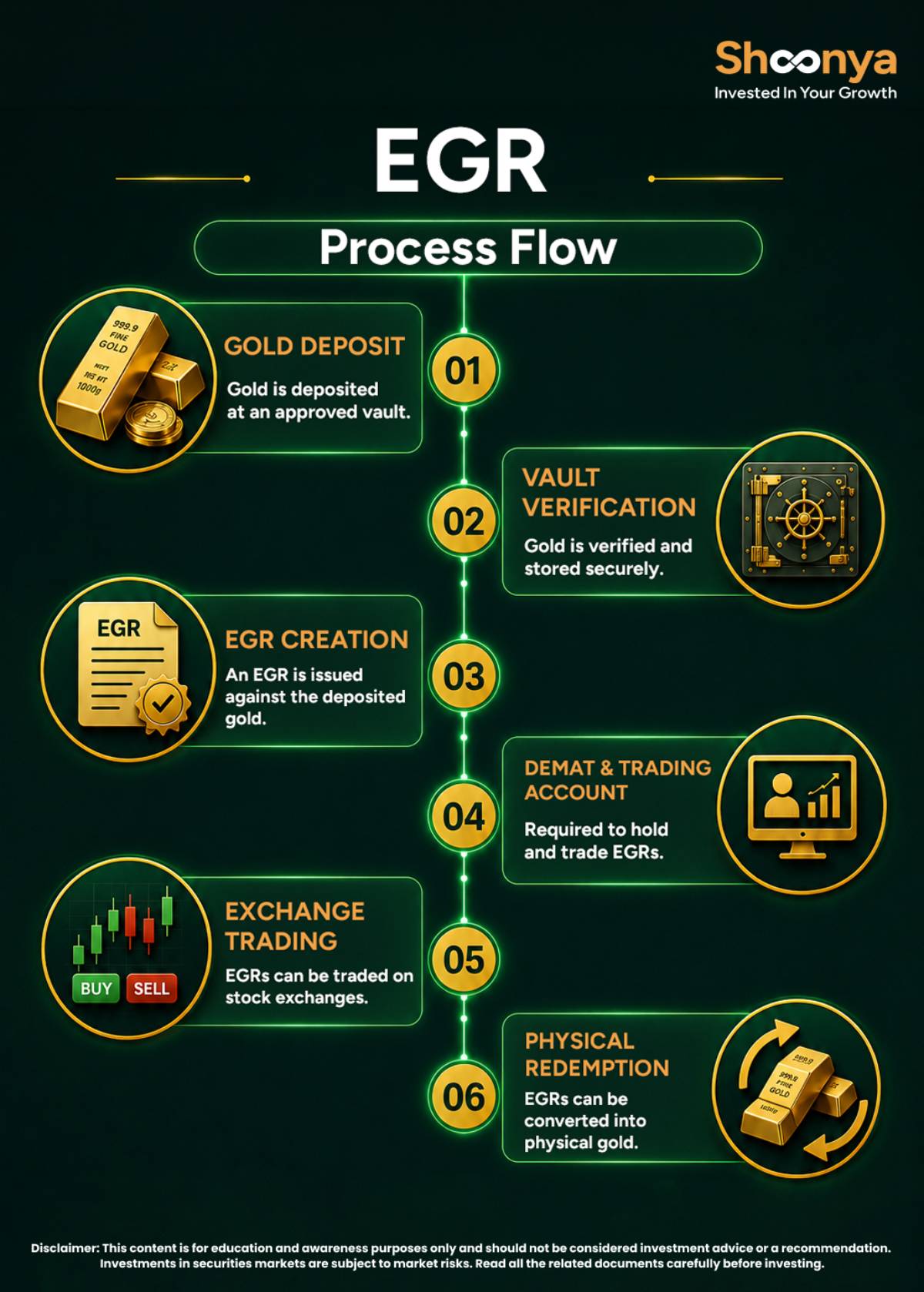
As shown above, physical gold is converted into an Electronic Gold Receipt and then traded on the exchange. Investors need a demat and trading account with a stockbroker to buy, hold and trade EGRs. They can also redeem EGRs for physical gold through the withdrawal process, subject to exchange and vault-related rules.
What are the Benefits of Electronic Gold Receipts?
EGRs make gold trading more structured and accessible for investors who prefer the exchange route.
Here are the detailed benefits of EGRs:
- Transparent pricing: Exchange-based trading helps investors see live market prices.
- Lower storage concern: Investors do not need to personally store gold while holding EGRs.
- Flexible participation: Smaller denominations make it easier to choose an amount that matches your investment size.
- Quality standardisation: Defined purity standards reduce common concerns around gold quality.
- Exit flexibility: Investors can sell EGRs on the exchange or withdraw them physically, subject to rules.
- Formal market access: EGRs bring gold trading into a regulated market structure.
How to Buy Electronic Gold Receipts in India?
To buy Electronic Gold Receipts in India, you need a trading account and a demat account with a stockbroker.
Here is the basic process:
- Open or use an existing demat and trading account.
- Check whether your broker provides access to EGR trading.
- Search for available EGR contracts on the trading platform.
- Choose the required purity and denomination.
- Place a buy order during market hours.
- After settlement, the EGR is credited to your demat account.
Note: Shoonya currently does not support the EGR segment, but it will be available soon. Meanwhile, you can open a demat account and stay ready for future EGR trading access.
What are the Gold Market Timings for EGR Trading?
EGR follows exchange-specified commodity trading timing.
The indicative EGR trading time is:
| Market | Timing |
| EGR Trading | 9:00 AM to 11:30 PM / 11:55 PM |
| Trading Days | Monday to Friday |
Disclaimer: EGR trading timings may change based on exchange regulations, market holidays, and daylight saving time adjustments. Investors should check the official exchange schedule for the latest timings.
Can You Convert EGRs to Physical Gold?
Yes, EGRs can be converted into physical gold through the prescribed withdrawal process.
To do this, the EGR holder must submit a withdrawal request through the depository or the relevant platform. After the request is processed, the EGR is extinguished, and physical gold can be collected or delivered in accordance with the applicable rules.
Before choosing physical conversion, you must check:
- minimum withdrawal quantity
- vault or delivery centre location
- purity and denomination rules
- applicable charges
- taxes or GST on gold, if any
- delivery timelines
Electronic Gold Receipts vs Different Ways to Invest in Gold
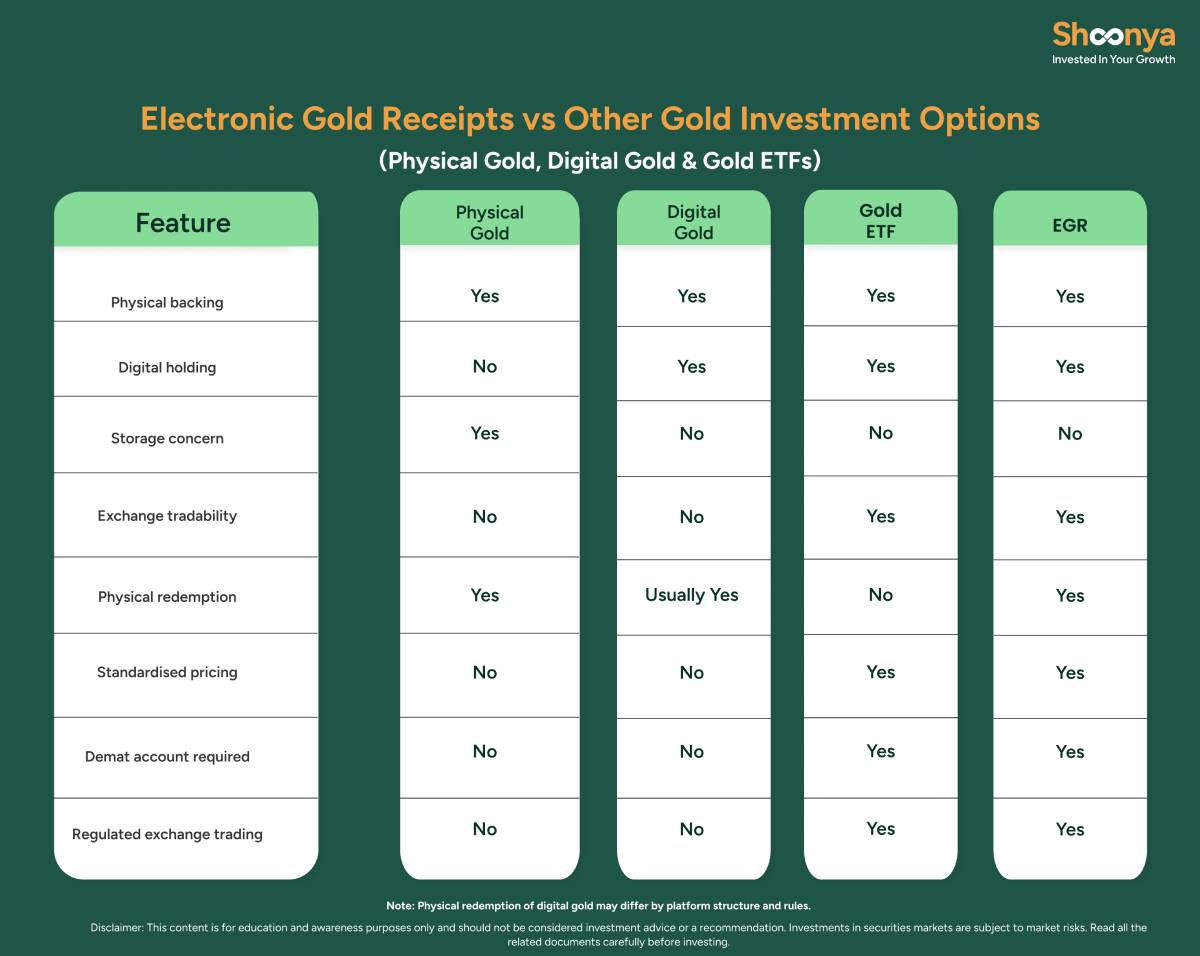
What is the Difference Between EGR and Gold ETF?
EGRs may suit investors who want gold-backed exchange trading with the option of physical withdrawal, while Gold ETFs may suit investors who only want exposure to gold prices.
Here are the points of difference:
| Basis | Electronic Gold Receipts | Gold ETFs |
| What you hold | A receipt representing deposited physical gold | Units of a fund that tracks gold prices |
| Underlying structure | Backed by specific physical gold deposited with a vault manager | Backed by gold held at the fund level |
| Physical conversion | Can be converted into physical gold through the prescribed process | Usually not available for retail investors |
| Purpose | Useful for trading gold with the option of physical withdrawal | Useful for taking gold price exposure without delivery |
| Denominations | Available in defined gold units such as grams/milligrams | Bought as ETF units based on the market price |
| Ecosystem involved | Exchange, depository, clearing corporation, and vault manager | Mutual fund house, custodian, exchange, and depository |
Gold ETF vs. Physical Gold: A Smarter Way to Invest in Gold
What is the Difference Between EGR and Digital Gold?
EGRs are better suited to investors who prefer exchange-based gold trading, while digital gold is typically used for simple app-based purchases.
| Basis | Electronic Gold Receipts | Digital Gold |
| Meaning | Exchange-traded receipts backed by physical gold | Online gold purchased through digital platforms |
| Trading | Traded on stock exchanges | Bought and sold through the platform, offering the product |
| Holding format | Held in a demat account | Usually reflected in the platform account |
| Regulation | Part of the regulated exchange ecosystem | Structure may vary across platforms |
| Physical conversion | Available through the prescribed process | Usually available, depending on platform rules |
| Price discovery | Exchange-based | Platform-based |
Who Should Invest in EGRs?
EGRs can suit investors who want to invest in gold digitally while retaining the option to convert it into physical gold later.
They may be suitable for:
- Long-term investors seeking gold exposure
- Traders looking for exchange liquidity
- Investors preferring gold in demat form
- Portfolio diversifiers adding a hedge asset
- Buyers want the option of physical gold delivery
What Should You Check Before Buying EGRs?
Before buying Electronic Gold Receipts, do not look only at the gold price. Also, check the trading, delivery, and cost-related details.
Here are a few factors that you should keep in mind before buying EGRs –
- Liquidity: Check whether the EGR contract has enough buyers and sellers.
- Denomination: Choose a unit size that matches your investment amount.
- Purity: Check whether the EGR is linked to 995 or 999 purity gold.
- Charges: Review brokerage, exchange charges, demat charges, and withdrawal-related costs.
- Delivery rules: If you plan to convert EGRs into physical gold, check the vault location, minimum withdrawal quantity, and delivery process.
- Tax impact: Selling EGRs or converting them may have tax implications.
- Price movement: EGR prices can be influenced by gold prices, currency movements, demand, and global market trends.
Are Electronic Gold Receipts Taxable?
Yes, EGRs are taxable when sold for a gain. Since EGRs are treated as securities, the tax depends mainly on the holding period.
| Transaction | Tax Treatment |
| EGR held for up to 12 months | Short-term capital gains are taxed according to your income tax slab |
| EGR held for more than 12 months | Long-term capital gains are taxed at 12.5% without indexation |
| Physical gold to EGR conversion | Not treated as a transfer for capital gains tax |
| EGR to physical gold conversion | Not treated as a transfer for capital gains tax |
| Physical delivery of gold | May attract 3% GST and other applicable charges |
| Buying or selling EGR on the exchange | Generally, no GST on the exchange transaction |
Note: Tax treatment can change based on updated rules, transaction type, and investor profile, so investors should check the latest tax rules or consult a tax professional before selling EGRs or taking physical delivery.
What Are the Risks & Limitations of EGRs?
EGRs offer a convenient way to invest in gold digitally, but factors such as price fluctuations, liquidity issues, and redemption conditions can affect investors.
Here are the key limitations:
- Gold prices can fluctuate based on market conditions
- Liquidity may vary depending on trading volumes
- Storage and vaulting charges may apply in some cases
- Physical redemption may involve additional costs and conditions
- Returns depend entirely on gold price movement without fixed income
Final Thoughts
Electronic Gold Receipts bring gold into a more organised, exchange-based format. They allow investors to trade gold in demat form while retaining the option of physical withdrawal.
For investors who want exposure to gold without handling physical gold at every step, EGRs can be worth exploring. Before investing, check liquidity, charges, taxation, denomination, and delivery rules.
Electronic Gold Receipts (EGRs): FAQs
You can buy Electronic Gold Receipts through a broker that offers access to the EGR segment on stock exchanges such as NSE. You need a trading account and a demat account to buy and hold EGRs.
A Gold ETF is a fund that tracks gold prices, while an EGR is an electronic receipt backed by physical gold. EGRs also offer the option to convert the receipt into physical gold through the prescribed process.
To buy EGR from NSE, log in to a broker platform that supports EGR trading, search for the listed EGR contract, check purity and denomination, and place a buy order during market hours. After settlement, the EGR is credited to your demat account.
Yes, physical gold can be sold to jewellers or authorised buyers, depending on their terms and purity checks. If you hold EGRs, you can sell them on the exchange, subject to market liquidity.
Yes, selling digital gold may be subject to capital gains tax if you make a profit. The tax depends on the holding period, gain amount, and current income tax rules.
Yes, EGRs can be converted into physical gold through the prescribed withdrawal process. Investors should check the minimum withdrawal quantity, vault location, delivery charges, and GST before choosing physical delivery.
EGR stands for Electronic Gold Receipt. It is a gold-backed electronic receipt that can be held in a demat account and traded on stock exchanges.
Yes, EGRs are taxable when sold for a gain. If held for up to 12 months, the gain is treated as a short-term capital gain and taxed as per your income tax slab. If held for more than 12 months, the gain is treated as long-term capital gain and is taxed at 12.5% without indexation.
Source: https://www.nseindia.com
Disclaimer: This content is for education and awareness purposes only and should not be considered investment advice or a recommendation. Investments in securities markets are subject to market risks. Read all the related documents carefully before investing.


Explore Our Offerings

Stocks
Trade equities across NSE and BSE with zero delivery charges. Invest, hold or sell with a seamless experience.


Future & Options
Execute complex strategies with simple tools and real-time data.

IPOs
Apply to the latest IPOs in just a few taps. Stay updated and capture opportunities as they open.