




September 18, 2025

September 10, 2025
July 3, 2025
January 10, 2025
RBI Repo Rate: What Happens When It Goes Up or Down?

Author
Shoonya Team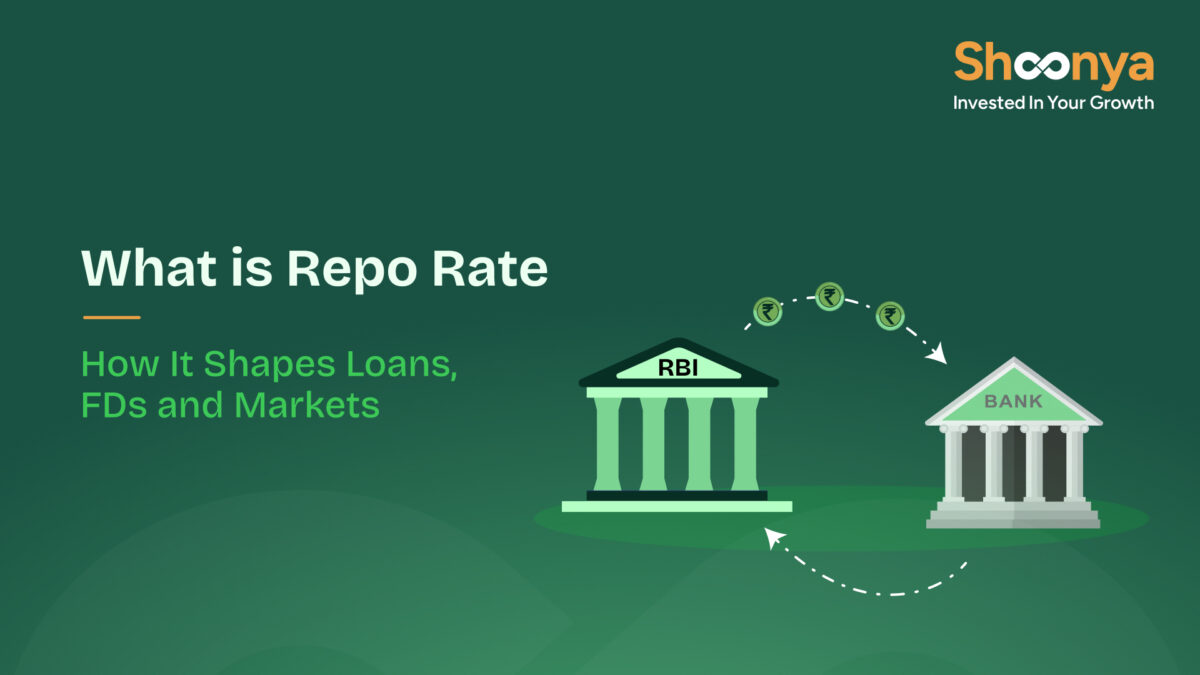
Your loan EMI does not change randomly. Every few weeks, the RBI announces its monetary policy, and one number that gets the most attention is the repo rate.
This rate can have a big impact on what banks charge for loans and the interest they offer on deposits. So, if you have a home loan, a personal loan, or a fixed deposit, it’s definitely something to keep an eye on.
In this blog, we will discuss what repo rate is, India’s current rate, and what happens when the RBI increases or decreases it.
What is Repo Rate?
The full form of repo rate is Repurchase Agreement Rate.
It is the interest rate at which the Reserve Bank of India lends short-term funds to commercial banks against government securities.
If the repo rate rises, borrowing becomes costlier for banks. If the repo rate falls, borrowing becomes cheaper for banks.
This change can affect:
- Home loan interest rates
- Personal loan interest rates
- Business loan rates
- Fixed deposit rates
- Inflation control
- Liquidity in the economy
- Stock market sentiment
How is the Repo Rate Measured?
Repo rate changes are usually measured in bps, or basis points.
1 basis point = 0.01%
25 basis points = 0.25%
50 basis points = 0.50%
100 basis points = 1%
For example, if the repo rate falls from 5.50% to 5.25%, it means a 25 bps cut.
Who Decides the Repo Rate?
The repo rate is decided by the RBI Monetary Policy Committee, also called the MPC.
The MPC reviews inflation, economic growth, liquidity, global risks, commodity prices, and domestic demand before deciding whether to increase, decrease, or keep the repo rate unchanged.
What is the Current Repo Rate in India?
The current RBI repo rate is 5.25%, as per the RBI Monetary Policy Committee decision announced on April 8, 2026. The MPC voted unanimously to keep the repo rate unchanged and continued with a neutral stance.
Why Does RBI Change the Repo Rate?
The RBI changes the repo rate to manage inflation, liquidity, and economic growth.
| RBI Action | Meaning | Common Impact |
| Repo rate increase | Borrowing becomes costlier | Helps control inflation |
| Repo rate decrease | Borrowing becomes cheaper | Supports borrowing and growth |
| Repo rate unchanged | RBI waits for more clarity | Rates may remain stable |
How Does Repo Rate Control Inflation?
Repo rate is used as a monetary policy tool to manage inflation.
- When inflation is high, the RBI may increase the repo rate. This makes borrowing costlier, reduces excess spending, and can help cool price rises.
- When inflation is low or growth needs support, the RBI may reduce the repo rate. This can make borrowing cheaper and support demand.
How Does Repo Rate Affect Home Loans?
Repo rate can directly affect home loan interest rates, especially if your loan is linked to an external benchmark such as the repo rate.
- When the RBI cuts the repo rate, banks may reduce repo-linked lending rates. This can lower home loan EMIs or reduce the loan tenure.
- When the repo rate increases, home loan rates may rise, leading to higher EMIs or a longer loan tenure.
Does RBI Repo Rate Cut Reduce Home Loan EMI?
A repo rate cut does not reduce every EMI immediately. The impact depends on:
- Whether your loan is repo-linked
- Your bank’s reset cycle
- Outstanding loan amount
- Remaining tenure
- Bank spread and other charges
For example, on a ₹50 lakh home loan for 20 years, if the interest rate falls from 8.50% to 8.25%, the EMI may reduce from around ₹43,391 to ₹42,603, saving about ₹788 per month.
Does Repo Rate Affect Personal Loan?
Yes, the repo rate can affect personal loans, but the impact may not be immediate.
Personal loans are unsecured loans, so banks also consider credit score, income, risk profile, and internal pricing. If the repo rate falls, new personal loan rates may become more competitive, but existing fixed-rate loans may not change.
How Does Repo Rate Affect FD?
When the repo rate rises, banks may increase FD rates to attract more deposits. When the repo rate falls, banks may gradually reduce FD rates.
However, FD rate changes are not automatic. Banks decide deposit rates based on liquidity, credit demand, competition, and funding needs.
Know FD vs Life Insurance: Which Investment Suits Your Needs Better?
What is the Reverse Repo Rate?
The reverse repo rate is the rate at which banks park surplus money with the RBI.
Repo rate controls the cost of borrowing for banks, while the reverse repo rate helps the RBI absorb excess liquidity from the banking system.
Repo Rate vs Reverse Repo Rate
| Factor | Repo Rate | Reverse Repo Rate |
| Meaning | RBI lends money to banks | RBI borrows money from banks |
| Purpose | Adds liquidity | Absorbs liquidity |
| Impact | Affects lending rates | Helps control excess money supply |
| Higher rate effect | Loans may become costlier | Banks may park more money with the RBI |
Key Takeaway for Borrowers and Investors
Repo rate trends help borrowers understand where loan costs may be headed and help investors read the broader market direction.
When repo rates fall, borrowing may become cheaper over time. When they rise, loan EMIs and borrowing costs may increase.
For investors, these rate changes can influence company funding costs, consumer demand, banking sector margins, and market sentiment.
Ready to follow the market beyond policy updates? Open a free Demat account with Shoonya and start exploring investment options.
RBI Repo Rate: FAQs
Repo rate is neither good nor bad by itself. A lower repo rate may make loans cheaper, while a higher repo rate may help control inflation.
The repo rate is the rate at which the RBI lends short-term funds to commercial banks. The current RBI repo rate is 5.25%.
CRR is the percentage of deposits that banks must keep with the RBI as cash reserves. Repo rate is the interest rate at which banks borrow money from the RBI.
Repo rate is the rate at which the RBI lends money to banks. The reverse repo rate is the rate at which the RBI borrows money from banks.
A 25 bps rate cut means the rate is reduced by 0.25%. For example, if the repo rate falls from 5.50% to 5.25%, it is a 25 bps cut.
EMI reduction depends on the loan amount, tenure, interest rate, and bank reset cycle. A repo rate cut may reduce EMI if your loan is linked to the repo rate.
A lower repo rate can be helpful for borrowers because banks may reduce loan interest rates. However, FD investors may get lower returns if deposit rates also fall.
When the repo rate rises, banks may increase FD rates to attract deposits. When the repo rate falls, FD rates may also reduce over time.
RBI has not announced a future repo rate cut. Any change depends on inflation, economic growth, liquidity, and the Monetary Policy Committee’s review.
Source: https://data.rbi.org.in/
Disclaimer: This content is for education and awareness purposes only and should not be considered investment advice or a recommendation. Investments in securities markets are subject to market risks. Read all the related documents carefully before investing.


Explore Our Offerings

Stocks
Trade equities across NSE and BSE with zero delivery charges. Invest, hold or sell with a seamless experience.


Future & Options
Execute complex strategies with simple tools and real-time data.

IPOs
Apply to the latest IPOs in just a few taps. Stay updated and capture opportunities as they open.