




August 26, 2026

September 18, 2025
September 10, 2025
July 3, 2025
Account Aggregator Framework Links 15 AAs With Nearly 170 FIPs for Credit Data Sharing

Author
Shoonya Team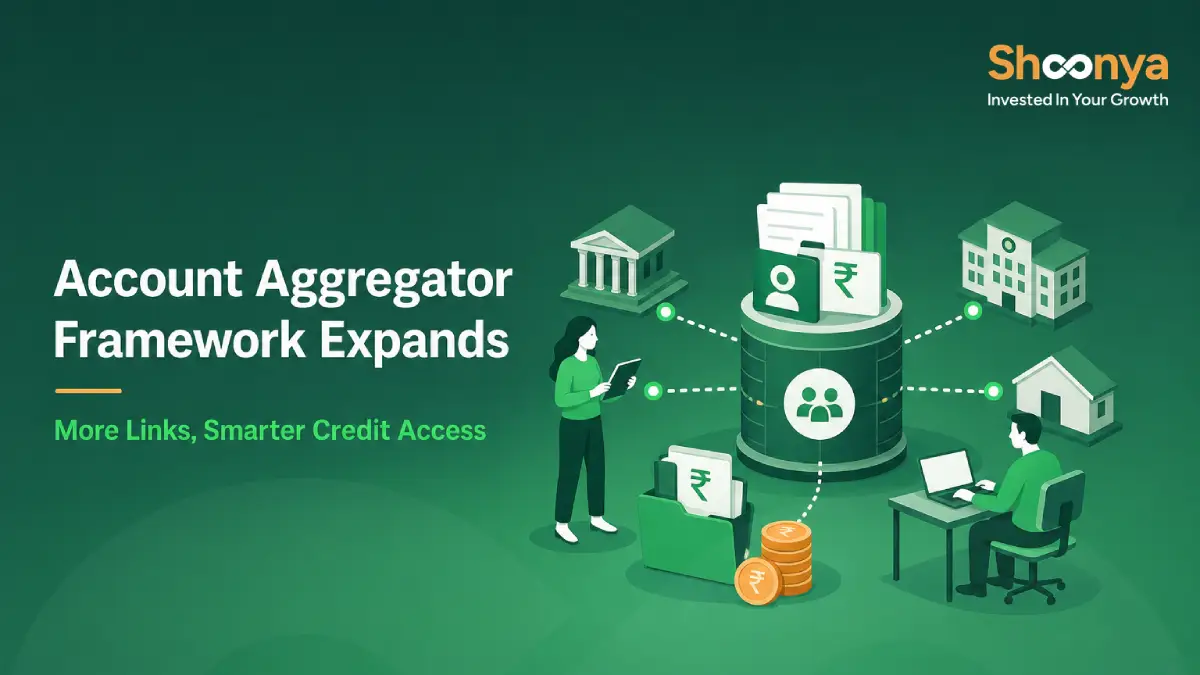
India’s Account Aggregator framework is reshaping how lenders access borrower data for credit assessment. Introduced by the Reserve Bank of India as part of the country’s digital financial infrastructure, the framework allows individuals and businesses to share financial information securely and only with consent across participating institutions.
The ecosystem currently includes around 15 entities licensed as Account Aggregators, integrates data from nearly 170 financial information providers, and connects more than 800 users who can receive consented data for use cases such as lending decisions.
Why the Account Aggregator Framework Is Important for Borrowers
For decades, formal credit in India leaned heavily on collateral such as land, property, or gold. That structure kept many economically active borrowers outside the formal lending system because they had income or business activity but limited assets to pledge.
Retail lending then moved towards bureau-based underwriting, where credit scores and repayment histories became central. The Account Aggregator framework adds another layer by allowing lenders to access trusted financial data directly from source institutions, with the borrower’s permission.
How Does the Account Aggregator Consent Process Work?
Account Aggregators do not approve or reject loans. They act as consent managers, enabling financial data to flow between institutions only when the customer authorises it. The framework operates through standardised application programming interfaces.
Each consent request defines three boundaries:
- Purpose: the reason the data is being requested
- Duration: the length of time access is permitted
- Scope: the specific financial information being shared
This structure puts the borrower at the centre of the process, rather than leaving data access unclear or invisible.
What Financial Data Can Lenders Access Through Account Aggregators?
The framework expands the information available for credit assessment beyond static indicators such as collateral or past repayment behaviour. Lenders can access more dynamic data that may better reflect current repayment capacity.
| Credit Assessment Input | What It Helps Show |
|---|---|
| Cash flows | Regular inflows and outflows in a borrower’s accounts |
| Income patterns | Stability or variability of earnings over time |
| Business receipts | Revenue movement for self-employed and business borrowers |
| Financial resilience | Ability to manage financial stress |
| Credit history | Past repayment behaviour from bureau records |
How Account Aggregators Work Alongside Credit Bureaus
The framework does not replace India’s four credit bureaus. It works alongside the existing bureau-led model by giving lenders more context about a borrower’s financial behaviour.
By combining bureau-based repayment history with bank and financial data accessed through the consent mechanism, lenders can build a more complete picture of borrower segments that conventional models have struggled to evaluate accurately.
How Account Aggregators Give Borrowers Control Over Their Financial Data
The key shift the framework introduces is visibility. Borrowers know what data they are sharing, why it is being requested, and how long the permission lasts.
That matters because financial data can be sensitive. The consent structure creates a clearer process for data access and gives individuals a more active role in using their own financial records for loan and other product applications.
What Are the Key Challenges in the Account Aggregator Ecosystem?
The Account Aggregator ecosystem depends on strong implementation across several areas:
- Process design and consent architecture must be clear enough for borrowers to understand what they are agreeing to.
- Customer awareness needs to improve so that data-sharing requests are not accepted without understanding.
- Data governance standards around security and privacy remain critical because the model depends entirely on trust in how financial information is handled.
Final Outlook
The Account Aggregator framework is adding a consent-led data layer to India’s credit system, giving borrowers a way to use their own financial records as an additional indicator of creditworthiness. Its broader impact will depend on how consistently institutions explain consent, protect privacy, and use the data responsibly. How consent frameworks evolve as data becomes more central to lending decisions will be the key area to watch.
Source: Mint


Explore Our Offerings

Stocks
Trade equities across NSE and BSE with zero delivery charges. Invest, hold or sell with a seamless experience.


Future & Options
Execute complex strategies with simple tools and real-time data.

IPOs
Apply to the latest IPOs in just a few taps. Stay updated and capture opportunities as they open.