




August 26, 2026

September 18, 2025
September 10, 2025
July 3, 2025
New ETF Trading Rules Start on September 7 With 10% and 6% Bands

Author
Shoonya Team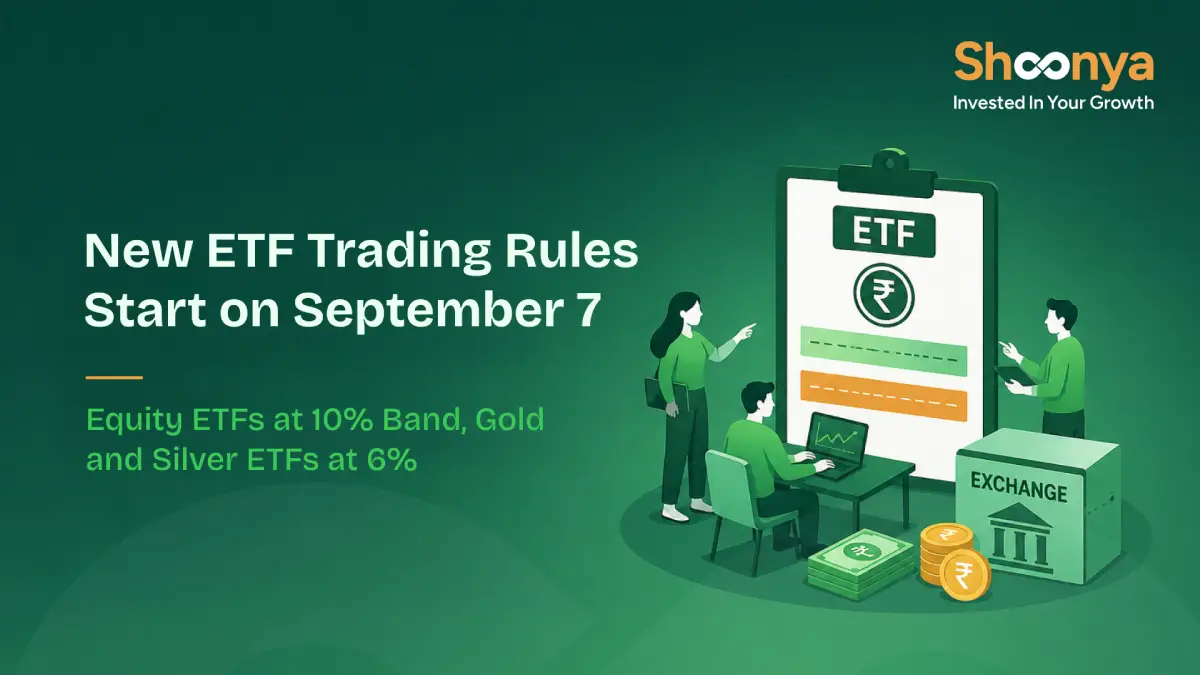
India’s ETF trading rules changed from September 7, altering how exchanges set daily price bands for exchange-traded funds. The new framework shifts the base price closer to actual market trading levels, introduces category-specific limits, and adds a pre-open auction for gold and silver ETFs.
Key Highlights
- SEBI’s June 15, 2026 circular replaced the earlier T-2 NAV-based reference with the previous session’s last 30-minute volume-weighted average price, or VWAP.
- Equity and debt ETFs now start with a 10% price band, which can expand up to 20% in stages after a 15-minute cooling-off pause.
- Gold and silver ETFs now open with a 6% band, with an additional 3% expansion allowed without an upper cap when prices move sharply.
- Overnight and liquid ETFs continue to trade within a fixed 5% band because their underlying values typically move less.
- SEBI’s August 28 circular shifted the rollout date from September 1 to September 7 while keeping the rest of the framework unchanged.
Why the Old Price Band Created Problems
Every ETF carries two important numbers: the NAV, which reflects the per-unit value of securities held by the fund, and the market price, which buyers and sellers determine through the trading day.
If an ETF’s Monday NAV was ₹100 and its underlying market value rose to ₹125 by Wednesday, a 20% band around the old ₹100 base would cap trading at ₹120, leaving a gap between the market price and fair value.
Balkrishn Bagaria, QPFP and Founder, Sharpe FinancialsETF Trading Rules Now Differ by Asset Class
SEBI’s framework assigns different band structures to categories to avoid applying the same limit to products that behave differently.
| ETF Category | Starting Band | Expansion Rule |
|---|---|---|
| Equity ETFs | 10% | Expands up to 20% in stages, with a 15-minute cooling-off pause each time |
| Debt ETFs | 10% | Expands up to 20% in stages, with a 15-minute cooling-off pause each time |
| Gold ETFs | 6% | Expands in 3% steps with no upper cap |
| Silver ETFs | 6% | Expands in 3% steps with no upper cap |
| Overnight ETFs | 5% | Fixed band |
| Liquid ETFs | 5% | Fixed band |
The unlimited expansion structure for gold and silver ETFs is particularly relevant because bullion prices trade globally outside Indian market hours. A large overnight move in global prices can now be absorbed through progressively wider bands.
Gold and Silver ETFs Get a Pre-Open Auction
Gold and silver ETFs will now begin each session with a pre-open call auction, similar to the mechanism used for individual stocks. During this window, buy and sell orders are collected before the market opens and matched at a single equilibrium price.
This replaces the earlier process where the first stray order could set the opening price. The new mechanism bases the opening level on combined demand and supply visible in the auction.
What Does This Mean for ETF Investors?
The new framework aims to make ETF prices more responsive to underlying asset values, especially during sharp market or commodity moves. Key points for investors:
- The rules may reduce situations where an ETF stays stuck at a band limit after its fair value has moved beyond that range
- The framework does not eliminate premiums or discounts to NAV
- Less-liquid ETFs can still trade away from fair value
- Investors should continue checking the indicative NAV and placing orders at appropriate levels
What Changes Again From April 1, 2027
SEBI’s circular sets up a second phase starting April 1, 2027. From that date, the base price will shift from the previous day’s last 30-minute VWAP to the previous day’s closing NAV. September 7 is therefore the first phase of the new framework.
Final Outlook
The September 7 changes address a structural issue in how Indian ETF prices move relative to underlying values, with the sharpest impact expected in gold and silver ETFs where global overnight price moves are most common. April 1, 2027, when the base-price framework changes again, will be the next key date for ETF market participants.


Explore Our Offerings

Stocks
Trade equities across NSE and BSE with zero delivery charges. Invest, hold or sell with a seamless experience.


Future & Options
Execute complex strategies with simple tools and real-time data.

IPOs
Apply to the latest IPOs in just a few taps. Stay updated and capture opportunities as they open.