




August 26, 2026

September 18, 2025
September 10, 2025
July 3, 2025
India’s FY27 Growth Forecast Trimmed by IMF and ADB Amid Oil Price Risks

Author
Shoonya Team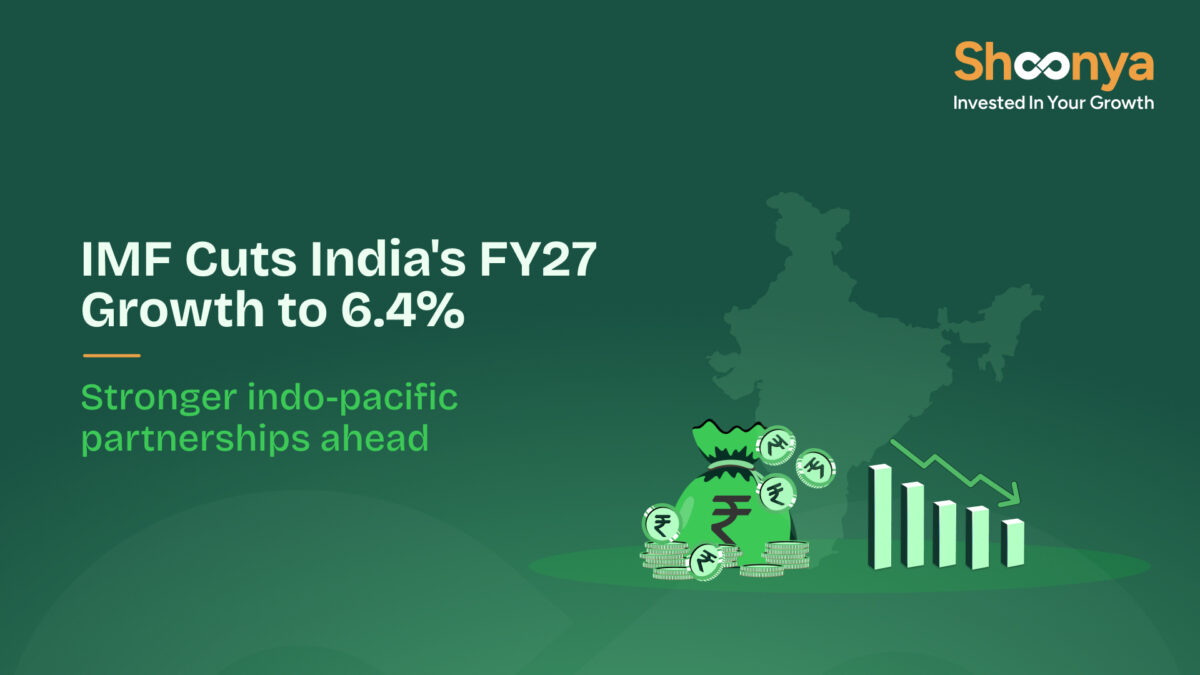
India widened its economic and strategic footprint across the Indo-Pacific this week, signing new agreements with Australia, New Zealand and Indonesia. At the same time, two global agencies trimmed the country’s growth outlook, and the rupee slipped to a one-month low amid a rise in crude oil prices.
Why Did IMF and ADB Lower India’s Growth Forecast?
The International Monetary Fund (IMF) cut India’s FY27 growth projection to 6.4 per cent from an earlier estimate of 6.5 per cent. The Asian Development Bank (ADB) made a sharper cut, lowering its forecast to 6.6 per cent from 6.9 per cent.
Both agencies pointed to rising crude oil prices and softer household purchasing power as the main drags on growth.
| Agency | Previous Forecast | Revised Forecast | Reason Cited |
|---|---|---|---|
| IMF | 6.5% | 6.4% | Oil price risks |
| ADB | 6.9% | 6.6% | Higher oil prices, weaker household spending |
How Is India Expanding Ties With Australia, New Zealand and Indonesia?
India used the week to deepen cooperation across energy, trade, defence and maritime security with three Indo-Pacific partners.
Australia
India and Australia activated arrangements for uranium supplies under their civil nuclear pact and unveiled 18 outcomes covering defence, maritime security, critical minerals and energy. Both sides also pushed to wrap up talks on a comprehensive economic agreement soon.
New Zealand
The two countries upgraded their relationship to a strategic partnership and set a target to double annual bilateral trade in goods and services to ₹35,000 crore by 2030. The agreements also covered maritime cooperation, reciprocal logistics support and early rollout of their free trade agreement.
Indonesia
India and Indonesia announced 20 outcomes, headlined by a missile agreement worth more than $600 million covering BrahMos cruise missiles and Astra air-to-air missiles. Both nations also agreed to explore reviving the stalled Sabang Port project and to deepen ties in critical minerals, digital infrastructure, local-currency trade and maritime security.
| Partner | Key Outcomes | Notable Deal |
|---|---|---|
| Australia | 18 outcomes; uranium supply pact activated | Push for early economic agreement |
| New Zealand | Strategic partnership; trade target set | ₹35,000 crore bilateral trade goal by 2030 |
| Indonesia | 20 outcomes | $600 million+ missile agreement (BrahMos, Astra) |
What Is Happening With the Rupee and Crude Oil Prices?
The rupee closed at 95.5550 per dollar, its weakest level in a month. The slide followed a surge in crude oil prices, driven by renewed tensions between the US and Iran.
Higher oil prices also fed directly into the growth downgrades from the IMF and ADB, since costlier crude tends to widen India’s import bill and squeeze household budgets.
Where Do India’s Trade Negotiations With the EU and US Stand?
The India-European Union free trade agreement is on track to be signed by December 2026 and implemented between April and June 2027, once ratification is complete, according to the EU’s chief negotiator.
Separately, India has asked the US Trade Representative to reconsider a proposed 12.5 per cent additional tariff. New Delhi argues that the forced-labour investigation behind the tariff proposal lacks country- and sector-specific evidence.
What New Policy Measures Did the Government Announce?
- Approved ₹1,237.58 crore under the PM-SETU scheme, extending the industry-led skilling programme to 200 Industrial Training Institute clusters.
- Waived basic customs duty on key electronics manufacturing inputs, with the exemption running until March 31, 2029.
What Do Higher Forex Reserves Indicate?
India’s foreign-exchange reserves rose by $7.26 billion to $674.193 billion in the week ended July 3. A stronger reserve buffer could give the Reserve Bank of India more room to manage rupee volatility if oil-driven pressure persists.
What Lies Ahead?
India’s diplomatic push across the Indo-Pacific and continuing trade talks with the EU and US could open new avenues for exports and investment in the coming quarters. However, growth may stay sensitive to crude oil price swings, and the rupee could remain under watch if US-Iran tensions persist. Investors may keep an eye on the EU FTA timeline and the progress of the USTR tariff review in the months ahead.


Explore Our Offerings

Stocks
Trade equities across NSE and BSE with zero delivery charges. Invest, hold or sell with a seamless experience.


Future & Options
Execute complex strategies with simple tools and real-time data.

IPOs
Apply to the latest IPOs in just a few taps. Stay updated and capture opportunities as they open.