




September 18, 2025

September 10, 2025
July 3, 2025
January 10, 2025
What is the Difference Between SIP or Lumpsum?

Author
Shoonya Team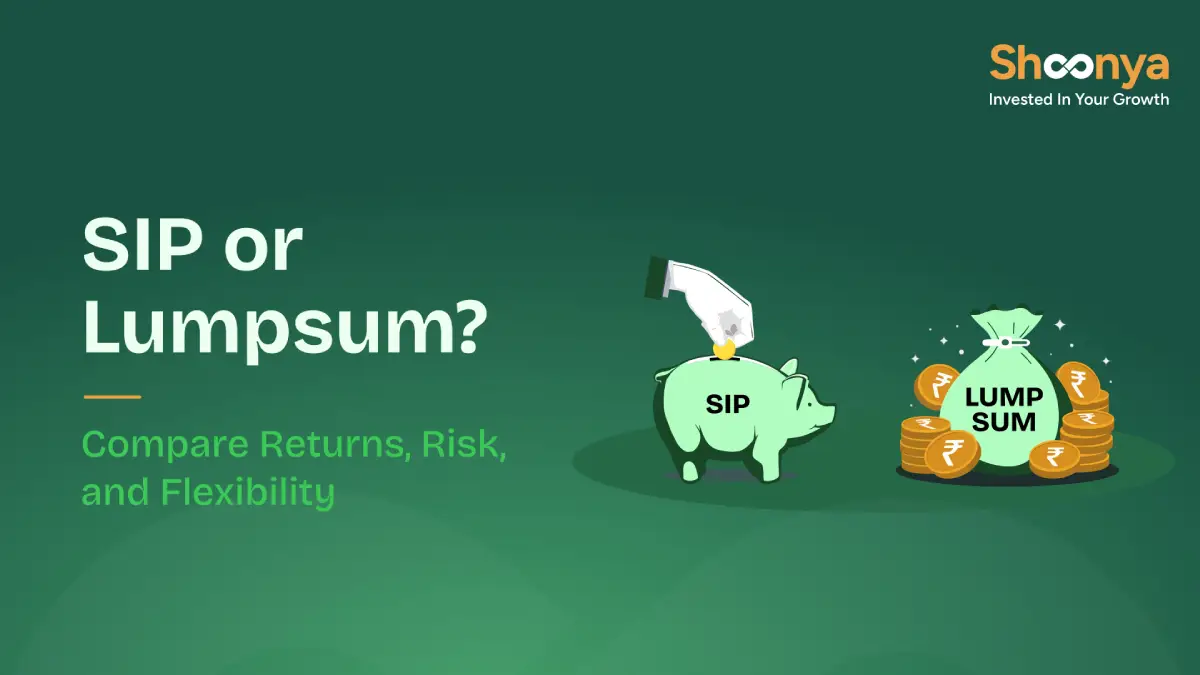
The stock market is unpredictable. Sometimes it rises steadily, and sometimes it fluctuates sharply within days. In such situations, one of the most common questions investors ask is whether SIP or lumpsum is the better option.
While both methods invest in the same mutual funds, they differ in how and when money enters the market. SIP allows you to invest gradually at regular intervals, whereas lumpsum investing puts the entire amount to work at once.
In this blog, we compare SIP vs lumpsum, their key differences, return potential, calculator use, and which option may suit you better.
What Is SIP?
A Systematic Investment Plan (SIP) is a method of investing a fixed amount in a mutual fund at regular intervals, such as monthly or quarterly. Instead of investing a large amount at once, SIP helps you invest gradually over time.
SIPs are commonly used by salaried investors because they support regular investing and reduce the need to time the market.
If you invest ₹5,000 every month in a mutual fund, it is called SIP investing.
What Is a Lumpsum Investment?
A lumpsum investment means investing a large amount in a mutual fund in one transaction. This option is usually used when you have surplus funds available, such as a bonus, savings, maturity amount, or idle cash. Since the full amount is invested at once, the investment is more exposed to market movement from the first day.
If you invest ₹1,20,000 at once in a mutual fund, it is called a lumpsum investment.
SIP vs Lumpsum: Returns and Flexibility Compared
SIP spreads investments over time, while lumpsum investing is more dependent on market conditions at the time of investment. Here’s the difference between the two:
| Basis | SIP | Lumpsum |
|---|---|---|
| Meaning | Fixed amount invested regularly | A large amount is invested at once |
| Investment style | Gradual investment | One-time investment |
| Market timing | Less dependent on timing | More affected by entry timing |
| Suitable for | Regular income earners | Investors with surplus funds |
| Flexibility | Can start with smaller amounts | Requires a larger amount upfront |
| Volatility impact | Helps average cost over time | Can see sharper short-term movement |
SIP vs Lumpsum: Risk Comparison
Both SIP and lumpsum carry mutual fund market risk, but the way investments react to market movements differs. In SIP, investments are spread across time. In lumpsum, the entire amount remains exposed from the beginning.
| Risk Factor | SIP | Lumpsum |
|---|---|---|
| Timing risk | Lower, as investment happens gradually | Higher, as the full amount is invested at once |
| Volatility impact | Spread across instalments | Immediate impact on full investment |
| Emotional pressure | Lower for regular investors | Higher if markets fall after investing |
| Return uncertainty | Depends on market levels across SIP dates | Depends more on entry point and holding period |
SIP vs Lumpsum: Which Gives Better Returns?
There is no fixed answer because returns depend on factors such as market movement, investment period, fund performance, and entry timing.
A lumpsum investment may do better when the market rises after you invest, because the full amount gets more time to grow. A SIP may work better in falling or volatile markets because you invest at different market levels.
| Market Situation | SIP or Lumpsum? | Why |
|---|---|---|
| Rising market | Lumpsum | The full amount gets invested from the start and can benefit from the upward movement. |
| Falling market | SIP | You can buy more units at lower NAVs over time. |
| Volatile market | SIP | Investment cost gets averaged across different market levels. |
| Long-term steady market | Both may work | Returns depend on fund performance and time invested. |
SIP vs Lumpsum for Beginners
SIPs are often considered easier for beginners because they allow gradual investing with smaller amounts. It may also reduce hesitation around market timing since investments continue automatically at regular intervals.
Lumpsum investing may suit investors who already have market experience, surplus funds, and the ability to stay invested despite short-term volatility.
Can You Invest Through Both SIP and Lumpsum?
Yes, many investors use both approaches together based on their financial situation. For example:
- Regular monthly savings may continue through SIP
- Bonus income or surplus cash may be invested through lumpsum
Using both methods can help balance disciplined investing with additional market participation whenever extra funds are available.
SIP vs Lumpsum: Which Is Better for You?
There is no universally better option between SIP and lumpsum. The suitable choice depends on how you earn, save, and respond to market volatility.
SIP may be suitable if:
- Regular monthly income is available
- Smaller investments are preferred
- Disciplined investing habits are important
- Market timing feels difficult
- Gradual participation feels more comfortable
Lumpsum may be suitable if:
- Surplus funds are already available
- Long-term investing is the primary goal
- Short-term volatility is manageable
- The investor is comfortable with market timing risk
- Emergency savings are already maintained
SIP vs Lumpsum for ELSS
ELSS, or the Equity Linked Savings Scheme, is a tax-saving mutual fund with a 3-year lock-in period. You can invest in ELSS through both SIP and lumpsum. However, the lock-in works differently in both cases.
| Investment Mode | How Lock-in Works in ELSS |
|---|---|
| SIP in ELSS | Every SIP instalment has a separate 3-year lock-in |
| Lumpsum in ELSS | The full investment has a 3-year lock-in from the investment date |
SIP Calculator vs Lumpsum Calculator
Before choosing between SIP and lumpsum, investors can estimate possible returns using online calculators.
A SIP calculator helps estimate the future value of regular monthly investments. It uses details such as SIP amount, expected return rate, and investment period.
A lumpsum calculator helps estimate the future value of a one-time investment. It uses the investment amount, expected return rate, and duration.
Calculator estimates are based on assumed rates of return and don’t guarantee actual returns. Mutual fund investments are subject to market risk.
Final Thoughts
SIP and lumpsum are two different ways to invest in mutual funds, and both can work well under different situations. SIP supports gradual investing and may help manage market volatility more comfortably. Lumpsum investing can be useful when surplus funds are available and the investor is comfortable with short-term market fluctuations.
To begin investing in mutual funds, open a demat account and explore options based on your goals and risk appetite.
SIP vs Lumpsum: FAQs
Which is better, a ₹2,000 SIP per month for 5 years or a ₹1,20,000 lump sum?
A lumpsum investment may perform better if the market rises steadily after the investment, while a SIP may help during volatile or falling markets by spreading purchases across different price levels.
Which is better, lumpsum or SIP?
SIP may suit regular income earners who prefer disciplined investing. Lumpsum may suit investors with surplus funds and a long investment horizon.
SIP vs lumpsum: which gives more returns?
Returns depend on market movement, investment duration, and fund performance. Lumpsum can deliver higher returns in a rising market, while SIP can perform better in volatile or correcting markets.
Which investment is 100% tax free?
No mutual fund investment is automatically 100% tax free in every case. Tax treatment depends on the fund type, holding period, capital gains, and current tax rules.
What is the difference between SIP and a mutual fund?
A mutual fund is an investment product, while SIP is a method of investing in that product regularly. Investors can invest in a mutual fund through SIP or lumpsum.
Can I invest in both SIP and lumpsum?
Yes, you can invest in mutual funds through both SIP and lumpsum investments. For example, you can invest surplus money as a lumpsum amount and continue investing your regular monthly savings through SIP.
Is SIP safer than lumpsum?
SIP is not risk-free because mutual fund returns depend on market performance. However, SIP spreads your investment across different market levels, which may reduce the risk of investing the full amount at one market point.
When should I choose lumpsum investment?
Lumpsum may be suitable when surplus funds are available, the investment horizon is long, and short-term market fluctuations are acceptable.


Explore Our Offerings

Stocks
Trade equities across NSE and BSE with zero delivery charges. Invest, hold or sell with a seamless experience.


Future & Options
Execute complex strategies with simple tools and real-time data.

IPOs
Apply to the latest IPOs in just a few taps. Stay updated and capture opportunities as they open.