




August 26, 2026

September 18, 2025
September 10, 2025
July 3, 2025
Call and Put Options: How They Work, Differences and Examples

Author
Shoonya Team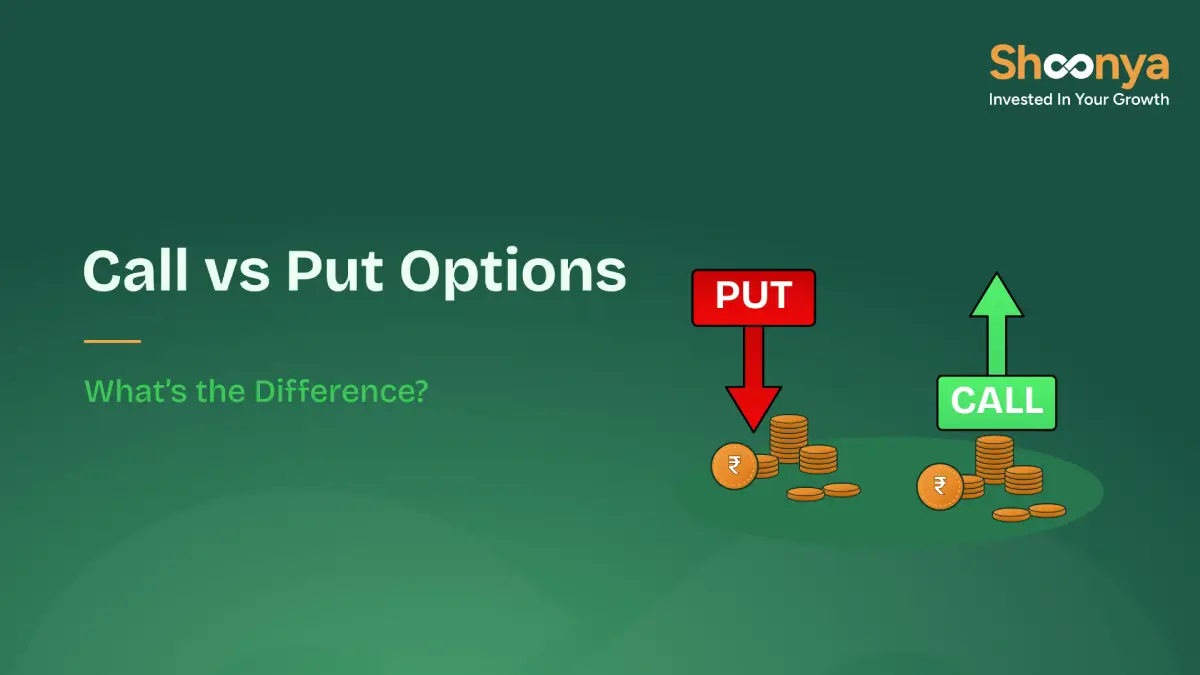
Call and Put options are the two basic types of options contracts used in the derivatives market. While both derive their value from an underlying asset, such as a stock or an index, they work in opposite directions.
A Call option gives the buyer the right to buy an underlying asset at a predetermined price, while a Put option gives the buyer the right to sell it at a predetermined price.
Your choice between a Call vs Put depends on your market view, the direction you expect prices to move and the strategy you want to use.
What Is a Call Option?
A Call option gives the buyer the right, but not the obligation, to buy an underlying asset at a predetermined price, known as the strike price, on or before expiry, depending on the type of contract.
Traders generally buy a Call option when they expect the price of the underlying asset to rise. This is why buying a Call option is commonly associated with a bullish market outlook.
The buyer pays an upfront amount called the option premium to purchase this right.
How Does a Call Option Work?
The value of a Call option changes based on factors such as the movement in the underlying asset, time to expiry and volatility. A favourable price movement can increase its value, while an unfavourable movement or time decay can reduce it.
Here is how call options work-
- Market view: Suppose an index is trading at 28,000 and you expect its value to increase.
- Buy a Call: You can buy a Call option at a suitable strike price and pay the applicable premium.
- If the market rises: The Call option’s value may increase, allowing you to potentially close the position at a profit.
- If the market falls: The option may lose value, and the buyer’s maximum loss is generally limited to the premium paid.
- For the seller: The Call seller receives the premium but may face significant losses if the underlying price rises sharply, particularly for an uncovered position.
Call Option Example
Suppose NIFTY is trading at 24,000. You expect it to rise and buy a 24,000 Call option at a premium of ₹100 per unit.
If NIFTY rises and the value of the option increases to ₹180, you may sell the option at the higher premium. Your profit before transaction costs would be ₹80 per unit.
However, if the market falls and the option loses its value, your loss as the buyer can be limited to the premium paid.
This is the basic idea behind a Call option. You are paying a premium to gain from a potential upward movement without having to purchase the underlying asset directly.
What Is a Put Option?
A Put option gives the buyer the right, but not the obligation, to sell an underlying asset at a predetermined strike price.
Traders generally buy a Put option when they expect the price of the underlying asset to fall. Therefore, buying a Put option is commonly associated with a bearish market outlook.
Like a Call option, the Put buyer pays a premium to purchase the contract.
How Does a Put Option Work?
A Put option gains value when the underlying asset moves below the strike price, though its actual value also depends on factors such as time to expiry and volatility. The buyer can close the position before expiry or exercise it as permitted by the contract.
- Choose a strike price: Select a Put option based on your market view and preferred strike price.
- Pay the premium: The buyer pays the option premium upfront.
- Price falls: The Put option may increase in value as the underlying price declines.
- Price rises: The Put option may lose value, with the buyer’s maximum loss generally limited to the premium paid.
- For the seller: The Put seller receives the premium but may face substantial losses if the underlying asset falls sharply.
Put Option Example
Suppose NIFTY is trading at 24,000, but you expect it to fall. You buy a 24,000 Put option at a premium of ₹100 per unit.
If NIFTY falls and the option premium rises to ₹180, you may sell the option and make a profit of ₹80 per unit before transaction costs.
However, if NIFTY rises and the Put option loses value, your loss as the buyer is generally limited to the ₹100 premium paid per unit.
This makes a Put option useful for traders who expect prices to decline and for investors looking to hedge against potential downside risk.
Call vs Put Option: What Is the Difference?
The most basic difference between a Call and Put option is the right that each contract gives to the buyer. A Call gives the right to buy, while a Put gives the right to sell.
However, there are several other differences to understand.
| Feature | Call Option | Put Option |
|---|---|---|
| Right given to the buyer | Right to buy the underlying asset | Right to sell the underlying asset |
| Typical buyer outlook | Bullish | Bearish |
| Buyer benefits when | The underlying price rises | The underlying price falls |
| Common use | Profiting from upward movements | Profiting from downward movements or hedging |
| Maximum loss for buyer | Generally limited to the premium paid | Generally limited to the premium paid |
| Seller’s maximum profit | Premium received | Premium received |
| Seller’s risk | Can be very high, particularly for uncovered Calls | Can be substantial if the underlying falls sharply |
Explore the detailed difference between bear market and bull market
Call and Put Option Payoff and Risk
The payoff of a Call or Put option depends on the underlying asset’s price at expiry relative to the strike price. Buyers have limited risk, while sellers can face significantly higher losses.
- Call buyer: Maximum loss is limited to the premium paid, while profit potential increases as the underlying price rises.
- Call seller: Maximum profit is limited to the premium received, while losses can be substantial and theoretically unlimited for an uncovered call.
- Put buyer: Maximum loss is limited to the premium paid, while profit increases as the underlying price falls, subject to the underlying price not falling below zero.
- Put seller: Maximum profit is limited to the premium received, while losses can be substantial if the underlying price falls sharply
Advantages of Call and Put Option Trading
Call and Put options can be used to take a market view, manage risk or hedge existing positions. They also allow traders to gain market exposure by paying a premium instead of the full value of the underlying asset.
- Limited risk for buyers: The maximum loss is generally limited to the premium paid.
- Hedging: Put options can help protect an existing portfolio against a fall in prices.
- Market flexibility: Calls can be used for a bullish view, while Puts can be used for a bearish view.
- Lower upfront amount: Option buyers pay a premium rather than the full value of the underlying asset.
- Strategy flexibility: Calls and Puts can be combined to create strategies for different market conditions.
Disadvantages of Call and Put Option Trading
Options can be complex and their value depends on more than just the direction of the market. Traders need to consider factors such as time to expiry, volatility and the premium paid.
- Time decay: An option can lose value as it approaches expiry.
- Premium can be lost: Buyers may lose the entire premium if the option expires without value.
- Higher risk for sellers: Option sellers can face substantial losses, especially with uncovered positions.
- Volatility impact: Changes in implied volatility can affect option prices even when the underlying asset moves as expected.
- Complexity: Choosing the right strike price, expiry and strategy requires a clear understanding of how options work.
Understanding Call vs Put OI
Open Interest, or OI, refers to the total number of outstanding option contracts that have not yet been closed, exercised or expired.
Traders often compare Call OI and Put OI to understand where significant options activity is concentrated.
What Does High Call OI Indicate?
High Call Open Interest at a particular strike may indicate that the strike is an important level being watched by the market.
When the data suggests substantial Call writing at a particular level, traders may view that strike as a potential resistance area. However, high Call OI alone does not guarantee that prices will stop rising there.
If market conditions change and call writers begin closing their positions, the market can move beyond that level.
What Does High Put OI Indicate?
Similarly, high Put Open Interest at a particular strike may indicate an important market level.
When substantial Put writing is observed, traders may treat that strike as a potential support area. However, support can weaken if those positions are closed or market sentiment changes.
This is why Call vs Put OI should always be analysed with price movement, changes in OI and overall market conditions.
Conclusion
Call and Put options offer different ways to participate in market movements and manage portfolio risk. However, options involve multiple factors that can affect outcomes, making it important to understand the contract and associated risks before trading.
Call vs Put Options : FAQs
What is the main difference between a Call option and a Put option?
A Call option gives the buyer the right to buy an underlying asset at a predetermined strike price, while a Put option gives the buyer the right to sell it at the strike price.
What is Call and Put option trading?
Call and Put option trading involves buying or selling options contracts based on a trader’s market view. Calls are commonly associated with upward price expectations, while Puts are commonly associated with downward price expectations.
What does Call vs Put OI mean?
Call vs Put OI compares the Open Interest in Call and Put contracts. Traders use this information to identify areas where options activity is concentrated and to understand changes in market positioning.
Can put and call options be used for hedging?
Yes. Put options are commonly used to potentially protect a portfolio against a decline in the value of an underlying asset. Other options strategies can also be used for hedging depending on the investor’s objective and risk profile.
Which is better, a Call or Put option?
Neither is always better. A Call option is generally used when you expect the underlying price to rise, while a Put option is generally used when you expect it to fall or when you want to hedge against a decline.
Is selling a Call option risky?
Yes. Selling an uncovered Call option can involve very high and theoretically unlimited loss if the underlying price rises sharply. A covered Call has a different risk profile because the seller already holds the underlying asset.


Explore Our Offerings

Stocks
Trade equities across NSE and BSE with zero delivery charges. Invest, hold or sell with a seamless experience.


Future & Options
Execute complex strategies with simple tools and real-time data.

IPOs
Apply to the latest IPOs in just a few taps. Stay updated and capture opportunities as they open.