




September 18, 2025

September 10, 2025
July 3, 2025
January 10, 2025
PAN Full Form: Purpose, Usage and How to Apply One Online

Author
Shoonya Team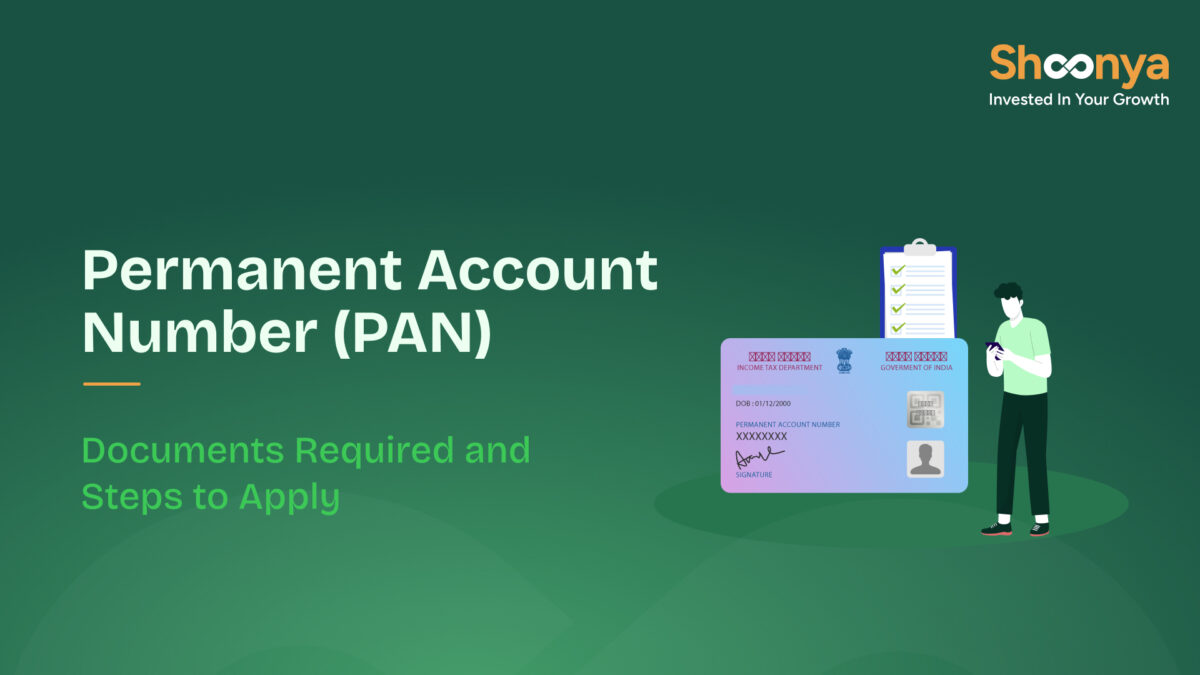
Did you know that one ten-character code controls your ability to file taxes, open a bank account, invest, or buy property in India? That code is your PAN. It is the most essential financial identity in the country.
Here is a clear guide to the PAN full form, its meaning, its uses, and the documents you need to complete the online application.
What Is a PAN Card?
‘PAN full form: Permanent Account Number’
It is a unique alphanumeric code printed on your PAN card issued by the Income Tax Department of India.
Every PAN is permanent, meaning it does not change with your address, job, or location. It acts as a universal financial ID that helps prevent tax evasion, ensures accurate financial reporting, and enables seamless access to banking and investment services.
PAN Card Number Format
A PAN is a 10-character alphanumeric code, and each character has a specific meaning. Here is the PAN number format:
1. First Three Letters (A–Z): These are random alphabetic characters assigned by the system.
2. Fourth Letter (Category Identifier): This letter tells you the type of PAN holder:
| Letter | Category |
| P | Individual person |
| C | Company |
| H | Hindu Undivided Family (HUF) |
| F | Partnership firm |
| A | Association of persons (AOP) |
| B | Body of individuals (BOI) |
| G | Government agency |
| J | Artificial juridical person |
| L | Local authority |
| T | Trust |
3. Fifth Letter: For individuals, this letter is the first letter of your last name (surname).
Example: If your surname is Sharma, your PAN’s fifth character will be S.
4. Numbers 6 to 9 (0001–9999): A four-digit sequence number generated by the system.
5. Tenth Character: A final alphabet is generated through a special algorithm to validate the PAN.
For instance, ABTPS1234F
- A B T → Random letters
- P → Individual
- S → Surname starts with S (e.g., Sharma)
- 1234 → Sequential number
- F → Check character
PAN Card Details: What Information Does It Contain?
Here is what you will find on a standard PAN card:
1.Permanent Account Number: A unique 10-character alphanumeric code that links all your tax and financial records.
2. Full Name: Your legal name as per government records. This includes first name, middle name (if any), and surname.
3. Father’s Name: Used as an additional identity marker.
(Note: PAN cards always display the father’s name. Even for married women, the husband’s name is not shown.)
4. Date of Birth / Date of Incorporation
- For individuals: Date of birth
- For companies/firms: Date of incorporation or registration
5. Photograph: A clear photograph for identification (for individuals only).
6. Signature: Your signature is printed on the card to verify your identity during documentation and financial signings.
7. QR Code: Newer PAN cards include a QR code that stores encrypted details for quick verification.
Learn Steps to Link Aadhaar Card with Mobile Number
What are the Documents Required for a PAN Card Online
To apply for a PAN card online, you need to submit three types of documents: proof of identity, proof of address, and proof of date of birth.
Below is a quick list of accepted documents.
| Document Type | Accepted Documents (Any One) |
| Proof of Identity | Aadhaar Card, Voter ID, Passport, Driving Licence |
| Proof of Address | Aadhaar Card, Bank account statement |
| Proof of Date of Birth | Birth certificate, Matriculation certificate, Aadhaar Card |
How to Apply for a PAN Card Online
You can complete the entire process through the NSDL (Protean) portal. Here’s how to do it:
Step 1: Visit the Official Portal
Go to the NSDL (Protean) website and select the option to apply for a new PAN.
Step 2: Choose the PAN Application Type and Applicant Category
- Form 49A: For Indian citizens
- Form 49AA: For foreign citizens
Select the category from the drop-down.
Step 3: Fill in Your Details
Enter your name, date of birth, email ID, and mobile number. Now, give consent.
Step 4: Upload Required Documents
Submit scanned copies of:
- Proof of identity
- Proof of address
- Proof of date of birth
- Photograph and signature
Make sure the files meet the specified size and format.
Step 5: Pay the Application Fee
Pay the applicable fee online using:
- Debit/credit card
- Net banking
- UPI
- Wallets
Step 6: Complete e-KYC or e-Sign
If you use Aadhaar-based e-KYC, no physical documents need to be sent. Your details are verified digitally.
Step 7: Receive Your Acknowledgement Number
After submission, you will get a 15-digit acknowledgement number to track your PAN application.
Step 8: PAN Card Issuance
- A digital PAN (e-PAN) is usually issued first.
- The physical PAN card is sent to your address after processing.
PAN card processing takes 7–15 working days, depending on verification.
What Is the Use of a PAN Card?
Here are the most important uses of a Permanent Account Number:
1. Filing Income Tax Returns: PAN is mandatory for filing ITR and for tracking all tax-related activities linked to your financial profile.
2. Opening a Bank Account: Whether savings, current, or salary accounts, banks require a PAN to verify identity and comply with KYC norms.
3. Investing in the Stock Market: Demat accounts, trading accounts, and mutual fund investments cannot be opened without a PAN.
Experience fast, reliable trading, open a Demat account and get started instantly.
4. High-Value Transactions: PAN is required when you:
- Deposit cash above ₹50,000
- Buy jewellery worth ₹2 lakh or more
Make large bank transfers or fixed deposits
5. Applying for Loans and Credit Cards: Banks and NBFCs ask for PAN to assess creditworthiness and verify financial history.
6. Buying or Selling Property: PAN ensures proper documentation and tax compliance in real estate transactions.
When Was PAN Introduced in India?
The Permanent Account Number system was introduced in India in 1972 to streamline the tracking of financial activity. However, the modern, computerised PAN system that we use today was launched later in 1995, making it easier to maintain accurate tax records and assign unique PAN numbers to individuals and businesses across the country.
This updated system helped centralise data, reduce duplication, and ensure that every taxpayer could be identified through a single, permanent number.
Final Thought
A Permanent Account Number is more than just a government-issued code; it is the foundation of your financial identity in India. From filing taxes and opening bank accounts to investing and making major purchases, your PAN ensures that every step of your financial journey is well-documented.
Have you linked your Pan card with your Aadhaar?
The current deadline is 31 December 2025. If you have not completed it yet, follow these quick steps.
What is PAN Card: FAQs
The full form of PAN is Permanent Account Number.
You can apply through the NSDL (Protean) or UTIITSL website by filling out the online form, uploading documents, paying the fee, and completing e-KYC.
You need proof of identity, proof of address, and proof of date of birth. Aadhaar, passport, voter ID, and birth certificates are commonly accepted.
It usually takes 7–15 working days after successful verification. An e-PAN may be issued earlier.
Yes, you can retrieve your PAN through the Income Tax e-Filing portal’s “Know Your PAN” service by verifying your details with OTP.
No, PAN and Aadhaar are not the same. PAN is used to track your financial and tax-related activities, while Aadhaar is used to verify your identity and address.
Source: https://uidai.gov.in/
Disclaimer: Investments in the securities market are subject to market risks; read all the related documents carefully before investing.


Explore Our Offerings

Stocks
Trade equities across NSE and BSE with zero delivery charges. Invest, hold or sell with a seamless experience.


Future & Options
Execute complex strategies with simple tools and real-time data.

IPOs
Apply to the latest IPOs in just a few taps. Stay updated and capture opportunities as they open.